
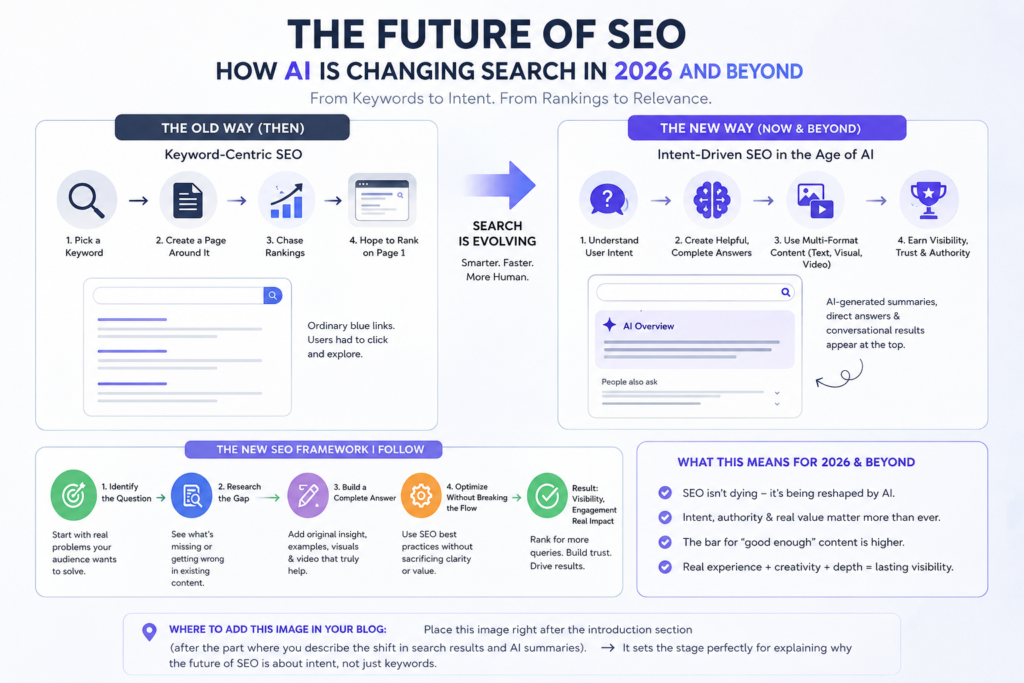
A few years ago, my SEO work looked pretty familiar: pick a keyword, build a page around it, chase rankings. Then I started noticing something different happening in the search results I was tracking.
Fewer plain “blue link” rankings. More direct answers. More conversational queries. More AI-generated summaries sitting right at the top of the page, answering the question before anyone even clicked through.
This isn’t a roundup of predictions pulled from someone else’s report. It’s what I’ve seen change, what’s worked, what hasn’t, and where I think things are genuinely headed — based on real client work, not guesswork.
Why the Future of SEO Isn’t About Keywords Anymore
For a long time, SEO success was measured almost entirely by keyword rankings. You picked your terms, optimized around them, and watched your position move up or down.
That model is breaking down. Search engines — and increasingly, AI search tools — are getting better at understanding intent, not just matching words. A search result today isn’t just judged on “does this page contain the keyword,” but on “does this page actually answer what the person wanted to know.”
That shift changed how I think about content entirely. Instead of asking “what keyword am I targeting,” the real question became “what is the person actually trying to solve, and am I answering it clearly?”
As someone who also works in content direction, this also pushed me to lean harder into video and visual storytelling alongside written content — because intent-driven search rewards content that genuinely helps, in whatever format does that best.
A Real Example: What Happens When You Optimize for Intent, Not Just Keywords
Theory is easy. Here’s what it looked like in practice.
On a local SEO project, instead of building content around a standard keyword list, I built it around the actual questions potential customers were typing into search — the specific, sometimes messy, real-world questions people ask before they buy or book something local.
The process looked like this:
Content was structured to give a direct, useful answer up front
Each page was supported with relevant visuals
Short-form video was added to reinforce key points
Over time, the content started gaining visibility for a wider range of related search queries — not just the exact phrases we originally targeted. The video content also picked up stronger engagement than the written content alone.
The lesson wasn’t “video beats text” or “questions beat keywords.” It was that when you build content around what someone is genuinely trying to figure out, search rewards you more broadly than when you narrowly chase one phrase.
My experience as the Best Freelance Digital Marketer in Thrissur has also taught me that local businesses need to think beyond traditional keyword targeting. Understanding what customers are searching for, answering their questions clearly, and creating content that reflects real local needs can make a much stronger impact than simply repeating a target keyword across a page.
The Biggest Mistake I See Businesses Making Right Now
Here’s the one I’d flag first if you asked me what to avoid: leaning too heavily on AI-generated content without adding anything real to it.
AI is genuinely useful for research, brainstorming, and speeding up early drafts. That’s not in question. The problem is when it becomes the entire content strategy — churning out large volumes of generic material with no real experience, originality, or point of view behind it.
Search engines and AI-driven search are both getting better at recognizing that kind of content for what it is: filler. Volume doesn’t build visibility or trust anymore, if it ever really did. What does is genuine expertise, real storytelling, a clear read on user intent, and content that actually answers the question someone came in with.
A Practical Framework for Content in the Age of AI Search
Given how much has shifted, I don’t plan content the way I used to. Here’s the process I follow now: Identify the real question. Start with the actual problems and questions your audience is trying to solve — not a keyword list.
Research the gap. Look at what’s already ranking and figure out what it’s missing or getting wrong.
Build a clear, complete answer. Combine original insight, real examples, and visuals or video where they add value.
Optimize without breaking the flow. Weave in SEO best practices — keywords, structure, formatting — without letting them override readability.
This process works for traditional search rankings, but it also happens to be exactly what conversational and AI-driven search tools are looking for: clear, well-structured, genuinely helpful answers.
How I See the Future of SEO in Practice
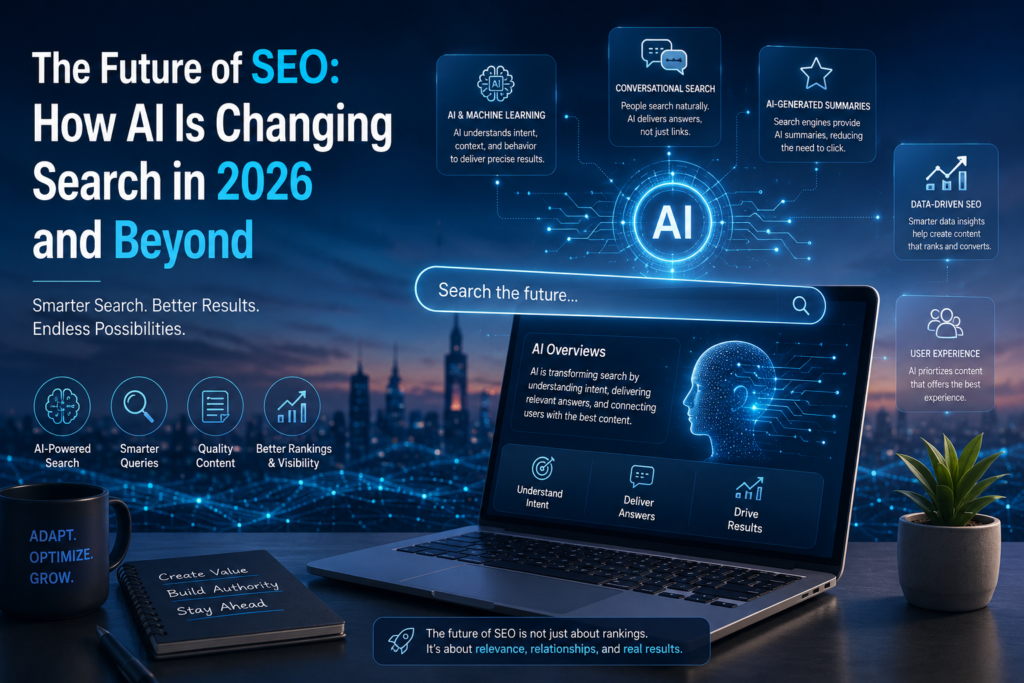
For me, the Future of SEO comes down to four important areas: understanding intent, demonstrating expertise, creating useful experiences, and adapting to new search interfaces. These areas work together rather than existing as separate SEO tactics.
A business may have excellent technical SEO, but if its content doesn’t answer the questions customers actually have, it can still struggle to earn visibility. Likewise, great content needs a technically accessible website and a clear structure so search engines can understand and discover it.
This is why the Future of SEO requires a more complete approach. Technical optimization still matters, but it needs to work alongside content quality, user experience, authority, and originality.
The Future of SEO: Where Search Is Headed by 2026
The Future of SEO will depend less on simply getting a page to rank and more on becoming a reliable source of information that both users and search systems can understand and trust.
Brands that combine expertise, original insights, useful content, strong structure, and engaging formats such as video will be better positioned for this changing search environment. Here’s my honest take: SEO isn’t disappearing, and it isn’t being replaced by AI. It’s being reshaped by it.
Keywords and rankings still matter — that part isn’t going away. But search intent, authority, and genuinely useful content are becoming the deciding factors, more than they ever were before.The mistake I see people making is assuming AI search means the end of SEO as a discipline.
It doesn’t. It means the bar for what counts as “good enough” content has gone up. When users can get a quick answer straight from an AI summary, the content that still earns a click — and earns trust — has to offer something that summary can’t: real experience, a distinct point of view, and depth an algorithm can’t fabricate.
The Future of SEO isn’t about producing more content. It’s about producing better content — content shaped by real human experience, creativity, and value that a generic AI output simply can’t replicate.
FAQs
Is SEO still relevant with AI-generated search results? Yes. AI is changing how search results are generated and displayed, but the underlying need — helping search engines and users find genuinely useful content — hasn’t gone away. SEO is adapting, not disappearing.
Will AI replace the need for content creators? Not entirely. AI is a strong tool for research and drafting, but content built purely on AI output without real experience or originality tends to underperform, especially as AI-driven search gets better at recognizing generic content.
What’s the biggest priority in Future of SEO for 2026?
Answering real user intent clearly and completely — supported by genuine expertise, examples, and, where possible, video or visual content — rather than optimizing narrowly around exact-match keywords.
Key Takeaways
Search is shifting from keyword-matching to intent-answering, and content strategy needs to follow.
Real-world examples and original insight outperform generic, high-volume AI content.
The Future of SEO rewards better content, genuine expertise, and user value rather than simply producing more content.
A simple framework — identify intent, research gaps, build a real answer, then optimize — works for both traditional and AI-driven search.The future of SEO rewards better content, not more content.